
Beltane
(Walpurgis Night, Zhivin Day, and the Celebration of Fires)
May 1st
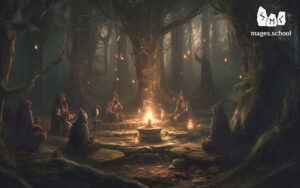
Beltane is celebrated on the night from April 30 to May 1. On this day, the element of Earth awakens. Stirred by Water, it opens itself up, releasing its power into the outer world. By the time Earth awakens, both Air and Water have already manifested the rhythm of time for the whole year: the tempo of events, the speed of change. Now, it is time for the Earth to reveal what has been done. Everything that was conceived and wished for must become visible, no longer remaining in the realm of fantasy. But for this to happen, Mother Earth must provide the space for manifestation. And she does, showing each individual a place of possibilities, an area of habitation. On this night, the night of Mother’s awakening, both people and mages performed their ritual acts.

People, in their ceremonial mystery, honored the power and will of the Earth, because, according to ancient legend, it was believed that on this night, the goddess chooses her husband. By lighting the May fires, celebrating and rejoicing as if at a wedding, our ancient ancestors seemed to say: your choice is sacred; we will heartily accept as our god the one you choose. It was believed that everything that occurred during Beltane had a mystical meaning and revealed, in one form or another, the will of the Mother. Competitions were scheduled for this day, things like the Tings and Veches (assemblies) were held, and on this day the future ruler underwent trials set by the priests.
Beltane night
This was the right of women to choose their destiny. The night when the ancient right of the Mother annulled all other unnatural laws. The night when any woman could unite with the Mother and absorb her power, thereby gaining the right to free choice. For ancient peoples, this was nothing surprising: any woman, without the need for additional magical efforts, was seen as the personification of the Earth goddess. But in a later era of worship of the faceless, nameless foreign god, women were left with only one day per year. One day when they could take their power and demand their rights, calling upon the ancient law of justice — the right of the Mother. And no one dared contradict her on this day, no one dared diminish her rights.
This is why no other pagan festivity made the clergy tremble as much as Walpurgis Night — the Night of a Thousand Fires of Beltane. The Churchmen feared this day (and its opposite, Samhain on November 1) so much that it caused them to writhe in terror.
In the Middle Ages, during the height of the Christian Inquisition, any woman became a witch when she opened herself to the Earth goddess. She would call upon her husband — the Great Horned God, Lord of the Forests and Fields. The Celts called him Cernunnos (or Kernunnos, Kern), Dionysus-Zagreus, the Green Man, and many other names across different cultures. This name served as a collective call for all the fallen gods of nature (hence the horns — an element connecting with the animal world). In uniting with him, the witch performed a magical act based on the principle of transference: she, in that night, was the goddess and, by right and law, united with her divine husband. It’s clear that such a union could bring no good for the foreign religion, and that’s why the clergy hated Beltane so fiercely, calling, in their impotent fury, this great mystery of union “copulation with a goat.”
The new religion, which feared with all its might anything connected to the power of nature and true magic, attached the most terrifying labels to this day. In medieval German mythology, the night from April 30 to May 1 (St. Walpurga’s Day, from which the name originates) was believed to be the time of the witches’ annual sabbat, when they would “fly on broomsticks and pitchforks to Brocken Mountain, gathering with other evil spirits around Satan.” Of course, they were said to engage in nefarious and godless activities — they practiced witchcraft. All that the warped minds of priests, suffering from complexes, starvation, prolonged celibacy, and fear, could conjure up, I will not repeat here. If you wish to delve into the history of the disease of those who curse their own nature (i.e., themselves), deny its right to be, you can enjoy the works of the churchmen of that time, as well as the chronicles of the witch trials conducted by the “holy inquisition” — everything is written there. We, however, will talk about the power, not about how to lose it in a most inept manner.
Beltane is the night when women reign supreme.
Among the druids and volhvs of ancient tradition, there were many of them. But on this night, it was only the woman, with her entire being, who could receive the power of the goddess and, for a brief moment, truly become her. In the process of such a union, she had access to all the memory of the Mother, the strength of all her children — humans and gods, plants and animals; the living and the yet unborn, the departed and those preparing to return. Not only the mages, but also ordinary people received power on this wondrous day of the Awakening of the Earth. One day a year, there is a time for people to remember that they have a right to power, before which all the gold of the domed churches and the rich robes of the priests fade, and the air is purified from the foul odors of incense and the words of lies. Because this power is real, and that is not.
The temple of the Mother is everything around us.
There is no need to lock it behind walls, to protect it with spells, or to draw channels. Because her home is the forests, the fields, the sky, and the rivers. It is everything in the circle, that which is born and is called nature, whose life, fortunately, depends neither on human laws nor on invented commandments. The Temple of the Mother does not need to be hidden, it does not need to be specially decorated — it is beautiful from the beginning. It does not need to be confined to walls — there are no walls strong enough to contain free will. Beltane night is an opportunity to see the absurdity of the foreigners’ struggle for the right to control the Mother’s power, the emptiness of their illusions — she will never accept them. And the mutilated, foreign invaders have no place in the forests of Mielikka.
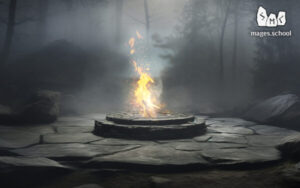
However, the mages, priests, druids, and volhvs not only led the ritual process but also directed its flow along the river of time into the future. The ritual itself was a help for all women of the tribe and family to become one, to become the Three-Faced Goddess, who defines the place for everyone and everything. Both young and old — all felt in this moment that what was happening was right; men, responding to the great power of women, no longer wanted or could be anything other than what she chooses — the Great God of Power and Strength. The druids and volhvs structured the ritual, guiding its movement, redistributing the awakened current of force to all the participants, to all living things. But with an eye to the future — in the power of the union of Sky and Earth, a child should be born. It was for this that the May fires were lit: they drew the fire of the coming world, which would be born in seven weeks.
Later, this powerful ritual was replaced by the selection of the May Queen and May King — a kind of compromise with the priests: from the whole tribe, only one woman and one man were chosen. It’s clear: to make the power of the Earth one’s own, to preserve the right to ancestral memory — this is far from enough. Thus, virgins and women would flee into the forest on the eve of May Night to find their Horned God, to listen to the forest, to the whisper of wild grasses and the prophetic cuckoo, to catch the hot breath of the Earth.
Do you hear — the rustling in the oak groves?
Do you hear — the music of the forest spirits?
Do you hear — the calling song of the grasses?
Do you hear — the wondrous dreams coming to life?
On May 1st, the Slavs celebrate Zhivin Day — the day of the goddess Zhiva, daughter of Lelya and Svarog. She represents the mature, motherly aspect of the Threefold Goddess of the Slavs: Lelya, Zhiva, and Mara-Marena, three sisters, three faces, three forces woven into one. The bird form of Zhiva is the cuckoo. One Polish chronicle says of the beliefs of the Slavs:
“A shrine was dedicated to the deity Zhiva on a mountain called after her, Zhivets, where, during the early days of May, a large crowd would reverently gather to honor her, as she was considered the source of life, long-lasting health, and well-being. Especially those who heard the first song of the cuckoo, predicting for them as many years of life as times as the bird’s song was repeated, would bring her offerings.”
The dream written on the egg during Ostara, the dream offered as a gift to the goddess, like a seed, must be planted in the earth and bear fruit in due time. But, in a wondrous way, on this day the gift previously offered to the goddess returns to the giver in the form of a new, altered fate. A fate in which there is no expectation of “heavenly manna” or other deserved and undeserved gifts. Every woman, becoming one with the Mother, with the Threefold Goddess on this night, perceives this gift as one given to herself, and the power returned by the Mother allows her to now create her own fate, to weave her own wyrd.
The mere realization of this fact can empower an ordinary woman to become a witch on this night. But the awakened power of the Mother on Beltane night is not only for women. All those who possess the primal force of the Original Children of Nature feel her call, and the power of the Horned God can be felt within every man — young and old alike. What awakens inside each one of the awakened leaves no room for old seals of belonging; it is capable of tearing off the slave’s collar from anyone who, on this day and hour, is able to feel her call and claim their own will and freedom. From her — by right.
Excerpt from the book “Health through the Power of the Elements” by Ksenia Menshikova.
Other pagan holidays of the Weel of the Year:
1 Imbolc 2 Ostara 3 Beltane 4 Litha (Kupala) 5 Lughnasadh (Lammas) 6 Mabon 7 Samhain 8 Yule
FORUM “MAGIC UNITED”: Festivities and Mysteries, the Wheel of the Year: Beltane
THE MAGAZINE: “THE WHEEL OF THE YEAR”