
Kupala
(Litha, Ligo, Yarilo, Yarilin Day, Summer Solstice)
June 20-23.
The Wheel of the Year continues its sacred turning. The pagan festivity of Kupala, marking the Summer Solstice, is celebrated from June 20 to June 23. During this period, the final element awakens — Fire. From this moment, all four elements are awakened, balanced, and united, like one family coming together after a long separation.
The moment of Fire’s arrival marks the birth of a new young god, the long-awaited firstborn of Mother Nature and her powerful consort, her chosen one. The night of Kupala is considered the most powerful of the entire year — not from a magical perspective, but from a human one. Mother Earth gives to this world the most precious thing she has — her child, her son. Alongside her, nature synchronously awakens, offering all that is best and most precious, presenting gifts to the new Lord.
It is for this reason that, feeling the magical power of this night, people, in hopes of a miracle that could not happen on any other day, would perform acts they would never have dared to do at any other time. Only on this day, even during the Christian era, could absolutely any act be free from the mark of “sin” — everything was allowed, everything was permitted. One could do what they wanted, love whom they wished, desire without fear — the key was to act honestly and sincerely. If there was no fear, no desire to deceive, and no violation of the unwritten rules of the sacredness of life, and fidelity to one’s word, then everything was possible. But if not — if the power of the birth of the new god was tainted by deceit and fear, then such a “gift” turned against the liar and thief — what they had done would return to them many times over.
This is what the mages of old taught and how they instructed their people: Do not lie, do not act out of selfishness, at least on this day! Not now, so as not to defile the newly born world with baseness and cowardice. Do not even let the thought enter your mind that such things are possible in a world that has been prepared for our children. And so, you will be protected from the need to fall into slavery for debts to the gods of the invaders: for a slave is one whose gods’ strength has abandoned him, one who has no one to protect him in times of trial.
The Slavs, like the Celts who deeply developed the traditions of Beltane, gave great importance to this day. Just as the Celts nurtured the soul of Beltane, the Slavs poured their hearts into the development of Kupala rituals. The god born of Mother Earth was called Kupalo by the Slavs.
Legends of the Fire Gods
A beautiful Slavic legend tells of the birth of the god Kupalo:
“The god of fierce Fire, Semargl Svarozhich, appeared to our distant ancestors in the form of a winged dog. Powerful and invincible, with a fiery sword in hand, he tirelessly defended the Sun from earthly evil, never leaving it for a moment.
But the stern heart of Semargl was not made of stone, as other gods had thought. Semargl burned with a genuine, passionate love for the goddess of the night, Kupalnitsa, and he knew that his feelings were returned.
Kupalnitsa called her lover every day to the shores of the beautiful Ra River, though she knew that Semargl could not leave the sky. But one day, in Semargl’s heart, the feeling of love overshadowed his sense of duty. The god left his celestial post and descended to the Ra River to finally embrace his beloved. After the proper time had passed for the gods, on the day of the summer solstice, Semargl and Kupalnitsa gave birth to children — Kupalo and Kostroma.
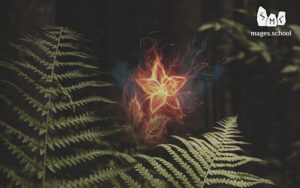
The thunder god Perun was very happy for his brother Semargl and presented a unique gift to the newborns. Perun placed a piece of his own strength into a fern that had never bloomed, and with this, he gifted the children of Semargl and Kupalnitsa a flower of extraordinary beauty”.
The god of the New World — Fire itself and the son of Fire, that is who Kupalo is. In the fiery nature of Semargl, life is impossible: his fire is primordial, fierce. This is the fire of the Titans, the fire giants, not for humans, but for gods, for mages. For humans, for nature and life, a different fire is needed — a fire that warms, revitalizes. Kupalnitsa-night — this is the dark, hidden power of the Mother — and Semargl, the son of Svarog, the god of another world, gave life to the living with a force of Light that does not kill or enslave, but, on the contrary, gives life, free will, and leads all who follow it.
The divine twins and gods of Light, born on the day of the Summer solstice, appear not only in Slavic myths. Apollo and Artemis, the gods of Greece, were also born to the goddess Leto on the day of the Summer solstice, according to legend. The “karmic twins” of the Slavs were similarly celebrated by the Celts, who told of the love of the god Dagda (whose name meant “flame of the god”) for the goddess of the river Boann, the keeper of ancient wisdom. From this love, the god Oengus Mac Og was born — the “young god,” the god of love and light, the god of fertility and all life.
The mystical power of Kupala night
The mystical power of Kupala night — it is the time of harmony and union, the time when all things stand equal before the inexhaustible force of life. Light is equal to Darkness, and Order merges with Chaos. Once again, the boundary between worlds disappears, everything mixes together, and the magical essence of nature spirits — mermaids, forest spirits, water spirits — flows into the ordered world of humans. All feel the birth of a new force — the force of unity. This is the force that blends realities, and for a few days, the new Fire, the new Light, perceives this mingling as natural. Later, of course, the boundaries will become firmer, the divided worlds will live their separate lives again. But according to magical law, anything that enters the light gains form and manifestation, both in the world of spirits and in the world of humans. On this night, the only night of the year when the law is active, we can all live together — both humans and non-humans. This is why it was important on Kupala night to be sincere and strong, not just to dream, but to follow your dream; not just to eagerly desire life, but to embrace all its manifestations without fear. Because any distortion of the purity of one’s freedom will inevitably affect the newborn force. But the law of balance will work in accordance: if a person fears and hates anything that is different from them, then they will be treated in the same way — and nowhere in the world of nature will they find support or help from the other children of the Mother.
Fire is the carrier of information
The more pronounced the element of Fire in a person, the greater their ability to spread information. Fire is expansion and passion, force and power of spirit, and the strength of Fire determines the manifestation of everything that is intended and must be fulfilled. But most importantly, it determines the freedom of the person, the right not to be anyone’s slave.
Ritual actions during this transitional period were guided by the volhvs and druids to awaken the proper Fire within themselves — it must be no less than the strength of the fire of the newborn god. Then Mother Earth will identify the person with her son and grant them her maternal protection, endowing them with an extraordinary destiny, one worthy only of gods and heroes. That is why the ritual was not only about lighting fires and cleansing with Kupala flames. One needed to awaken all the elements that had already awakened and make them as strong as possible within oneself — as much as consciousness could bear. Then the strength of Fire would also be strong, for there must be enough fire to absorb the power of Earth, Air, and Water, complementing and uniting them within itself, and itself within them. One equals the strength of three — this is the Fire that must exist during Kupala night.
Kupala rites
Kupala rites must be performed in nature, by water, in the open space. On this night, the union with the power of the elements, the newborn Fire-Kupalo, son of Semargl, would vividly manifest its nature of unity and love, the free acceptance of all things — without restrictions, without prohibitions.
But the magical ritual performed by the volhvs and druids without spectators was somewhat different from the ritual actions carried out by the people. The mages performed a ritual aimed at activating the power of the father of the young god, the winged Semargl himself. For people, the power of Semargl is as dangerous as the power of any Titan, but not for those whose task was not only to protect but also to lead the tribe, the family, the people (for any tribe is also the result of agreement and voluntary union).
By awakening the power of the primordial fire of Semargl, the mages ensured their support and protection during the time the young, newborn god would grow, gain strength, and acquire the necessary experience. Semargl, having an inherent fiery nature, can handle any fire, even that which is foreign. If it turns out that the strength of the young god Kupalo is not enough to ward off the black cloud that hides the sun from people, then Semargl Svarozhich himself must take the place of his son, open his source of Fire, and prevent life from ending. Semargl is the “reserve” energy, to use the language of the present age. With this action, the mages anticipated the problems that the Winds of Imbolc had forewarned them about.
But for the people, for now, it is happiness and joy; in the moment of transitioning through Kupala night, no fear or doubt should creep into their hearts. Yet those who bear responsibility for the lives of the people must think ahead: what needs to be done now so that tomorrow the strength of the gods does not depart from the people, so that the spark of Kupalo’s Fire does not extinguish in the hearts of humans, so that the blood of the young god does not cool in the veins of every living being.
Strength and health on the night of the Kupala bonfires
Human health—the very subject first spoken of—receives strength and restoration on the night of the Kupala bonfires. To bathe, to leap over the sacred flames, to praise the Earth that nourishes, the Air and the Water that grant the time of life, and, of course, the Fire—the new god of a blessed season. He will endure every trial, provided that the flame within human hearts does not go out. On this day, one must awaken the longing for life—a longing so powerful that it reveals the true meaning: what it is to be healthy for, and what it is to live for.
Excerpt from the book “Health through the Power of the Elements” by Ksenia Menshikova.
Other pagan holidays of the Weel of the Year:
1 Imbolc 2 Ostara 3 Beltane 4 Litha (Kupala) 5 Lughnasadh (Lammas) 6 Mabon 7 Samhain 8 Yule
FORUM “MAGIC UNITED”: Festivities and Mysteries, the Wheel of the Year: Kupala
THE MAGAZINE: “THE WHEEL OF THE YEAR”