
Mabon
(Ovsen, The Autumn Equinox)
September 20-23.
From this day forward, in the world of nature, the element of Water begins to fall into dormancy. The combination of Air and Water creates the flow of time, but as the element of Air falls into slumber, this flow seems to slow, and the diminishing activity of Water almost brings it to a halt. The myth of the birth and development of the young god speaks of how his quest for power and knowledge takes him away from this world.
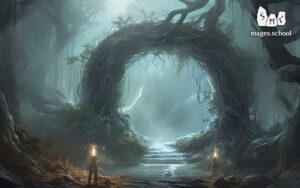
On Mabon, the seeker of power and wisdom sets out across the waters to Avalon, the Isle of Apples, the realm of mages, witches, sorcerers, and the old gods. He travels to the world of those who now manifest themselves in active deeds in other realms. Yet they, the ancient ones, remain the keepers of the old knowledge — knowledge that no one among humans remembers today. But the power of the future god must be real, and he must rely on the knowledge of the distant past, on the wisdom of all the worlds, all gods, and all systems that once worked with their strength. Therefore, the young god of Fire journeys into Darkness — to where the true knowledge is hidden.
Remaining in the physical world, humans, with their minds, followed him — they watched the sun as it set, tracked the birds as they flew away, observed the nature falling asleep, and faintly sensed the halting of time, a sense of abandonment, the feeling of power slipping away from them.
Light becomes equal to Darkness, but Light fades away, and Darkness remains. Its reign frightens the living because from the world of Darkness emerge other children of the Mother, and their time has come. They arrive to take the place of the departed young god in search of knowledge, for nature abhors a vacuum.
Period of trials
For humans, this period is a time of trials for resilience. Without support, without relying on external forces, they can now only rely on what they have accumulated, on what they have managed to achieve by this point. Now, while the elements have not yet begun to return, this will be a period of trials where the examiners will be forces that are anything but friendly toward humans. These ancient forces, who came in place of the young god of Fire from the world that took him, to bestow the strength of the Ancients, possess only that strength — and only that strength. These ancient children of the Mother existed long before humanity’s birth, when they were the sole masters of the inhabited world. The presence of humans is unwelcome to them — and that is an understatement. But the will of the Mother is the law for all. However, the trials that living beings must endure are never merciful for this reason.
The coming cold, the “dying” nature, the departing birds — all life seems to flee away from places where, with each passing day, the gates to the world of Death and Darkness are opened wider. The current flowing from there is like a cold, piercing wind that strips away not only nature’s coverings but also the human being — revealing them for who they truly are. And what is a human being without strength and support? Without the familiar feeling of their god’s protection? For the connection to their god grows fainter, the thread binding the minds of the human and the god thinning, as power flows between them more weakly.
Mother Earth, the Great Goddess, weeps for her departed son. She releases him so that another may return, but how great is the grief of a mother who knows she will never see her child again.
A person learns to remain faithful and honest, never betraying their own force, no matter the circumstances.
After Water falls asleep, the world seems to stop around it; time halts, and both the human and the young god descend into the sensation of the world of Death. Driven by deep, unspoken fear, humans draw closer to one another, seeking protection not only from the strong of the world but also from unseen yet familiar forces — from their ancestors, long departed to other worlds. And only those who could not do otherwise would follow in the footsteps of their god, stepping with open eyes into the world of Darkness, guided by the lingonberries growing in abundance on the moss of the bogs, as if following drops of blood, they would find his path. They are the ones who decided to dedicate themselves to the unseen force, the force of magic, for it is at this time that the stages of magical initiation for the volhvs and druids begin. Not for everyone, of course. The Line of Dark Mages followed their god into the study of their own path and stages of initiation, while the Line of the Light remained with the people to help them survive the dark and difficult times: to endure the test of separation and teach people to preserve resilience and faith, to live and grow through their own reason, even when no one from the Higher Realms is helping them. It is precisely on the day of the Autumn Equinox that the gods’ power determines who will walk which path.
The Ancients believed that if people, feeling no connection to their god, managed to preserve everything that he had given them in the short period of his power, and if, upon his return, his children were not weakened or betrayed, it would mean that both the people and the god had gone through their stages of growth and had truly become equals: gods and humans. A human being was meant to mature and learn alongside their god, to learn how to be loyal and honest with him, to not betray their force, no matter the circumstances.
The Eleusinian mysteries
In Ancient Greece, during the Autumn Equinox, the famous Eleusinian Mysteries were held for nine days, and their essence was the same — to unite with one’s god, to follow his path, to be initiated into the realm of Hades, to pass through ritual death. However, the almost “theatrical” reenactments of the myth of Demeter and Persephone had little to do with the true sacred rites: for the people, it was one thing, and for the mages, it was something entirely different.
In Russia, the day of the Autumn Equinox was called Ovsen. Ovsen (also known as Avsen, Usen; Tausen, Kitin — in Belarusian) was the god of labor, the protector of horses, bridges, and plowing, and a Slavic god of the harvest. When Kupalo (the summer god) departed into Darkness, Ovsen was meant to remain in his place. He was to teach people everything that comprised the traditions of the Old Gods, to help them live without the departed young god, but to learn to wait for his return, without betraying or faltering. In ancient times, it was believed that Ovsen should build a bridge across the Smorodina River, “open the way,” so that Kupalo could return from the world of the dead.
This myth was preserved in the folk memory as the tale of Usila Dobry (Usila the Good). It served as a reminder that betrayal of one’s strength always turns against the betrayer. For serving a foreign god out of fear or cowardice, there would be many misfortunes for the betrayer and their children.
In ancient times, in the old days, our Ancestors lived in the forests and steppes. They did not sow wheat but exchanged it for meat, hides, lard, and sheep’s wool. They lived simply but happily, with little knowledge—just what was necessary. They carved it on a log, and that was enough for their work.
Our Ancestors were upright, honest, kind, and never boasted in front of one another. They led cattle across the steppes to graze, cared for lambs and children, and each person knew their horse as a man knows the bridle, and each knew their cattle as a scholar knows a book. If a cow fell ill, they knew how to treat it, and if a person became sick, they knew how to heal them.
They only spoke the truth to one another. No one lied, they listened to the elders, respected grandfathers, revered grandmothers, guarded children, protected wives, and helped the weak. They offered food, drink, a place by the fire, and shelter to every traveler. And when they saw a thief, they rode after him on horseback and drove him away from their flocks.
Our Ancestors had a king named Usila the Good. Like all his people, the king slept in a cart, covered with a blanket, and used a saddle for a pillow. At night, he would get up to check the sentinels, and woe to the one who fell asleep in the grass!
At dawn, our Forefathers would rise, pray to the bright Dawn, and say: “Glory to you, bright Dawn, shine in the sky! You rise early, come to us like a good wife, bringing your milk and pouring it into the steppe. Be happy, Shepherd Dawn! Accept the bow from the father and mother, accept the bow from the grandfather and grandmother, and from our brother who passed early, and our sister who died! May they burn in the blue sky as stars, shining to us from Svarog’s Iriya!”
Thus, our Ancestors prayed, praising the gods, and the gods gave them everything good that was necessary for life. But they also did not give them excess, for the gods knew that excess wears a person out, that excess spoils the wife, that sons run wild, abandon work, daughters marry off to strangers, and from excess, a person is left alone with themselves, unnecessary to everyone.
But in those days, people were kind, helped their neighbors, and did not ask for payment for their work. The youth of those times respected the elders, were kind to the younger ones, and lived simply. They cared for the purity of Kupala, knew no malice or envy toward one another. And God would come to them in simple clothes, speak with them, and give them advice. The people, in their simplicity, thought it was the old grandfather visiting them, and answered him respectfully. And then, suddenly, they saw that the old man walked on the earth, and then he walked in the sky, along the Milky Way, which the Dawn poured out from her pitcher.
Once, the children were playing in the grass, and a little girl was digging the earth, planting grass stems in it. An Old White Man came to her and praised her: “Good, child, you must sow!” He gave her various seeds and told her to plant and water them often. The girl did as the Old Man told her, and within a week, the sprouts began to appear. She watered them all summer, and the cucumbers, melons, and watermelons ripened. Everyone was amazed, ate, praised her, and collected new seeds. And from that time, people began to plow the earth, sow seeds in it, and learned the art of farming.
They began to sow peas, lentils, beans, and all sorts of legumes. Later, they grew steppe onions and garlic in their gardens. And people had more to eat than just milk, butter, and dry cottage cheese.
And the king Usila the Good himself carved a plow out of oak, yoked oxen, plowed the land, and sowed wheat. When the harvest ripened, he praised the gods, offered the First Sheaf to Dazhbog, poured a cup of honey, and splashed it on the earth for Zemnobog—making offerings as was customary.
Our Ancestors, the Grandfathers and Forefathers, began to plow the earth, sow grain, and praise the gods, for they no longer needed to exchange cattle and sheep for flour.
And then a distant merchant arrived, showing them gold and silver, offering it in exchange for hides, lard, beef, and sheepskins. Queen Godynya, the wife of Usila, gathered silver and gold, began to adorn herself, winding it into her hair, wearing rings and bracelets, and dressing her body in brocade and velvet. All the other women began to do the same.
The girls began to dress up like the women, and the young men followed by gilding their swords and silver-plating their bridles. They began to envy one another—who had the more beautiful bridle or saddle—and started to boast of themselves, laughing at others. The former simplicity disappeared, and life became dull and strange. Even King Usila became bored, and his wife urged him to go to war to seize even more silver and gold from another king.
And because of those thoughts about excess, people’s lives became greedy and harsh. They had to prepare for war, craft weapons, build forges, forge swords, make strong knives, sharp spears, and march to war in the middle of summer.
When the neighboring king heard about it, he began to prepare for defense. He taught his people to ride horses, to gallop across the open fields, and to hold their ground. And when King Usila led his army—armed with swords, pitchforks, and other weapons—the neighboring king sent his own soldiers out, and a great battle began. Many people fell, and there was plenty of food for the crows. And that Evil began to spread across the steppe, so much so that even distant neighbors turned against each other, and throughout the land where the Ancestors had lived, one king rose against another.
And from this came only loss: cattle were eaten, crops trampled, pots broken—there was nothing left to eat. The Grandfathers began to complain and blamed Queen Godynya, saying that if it weren’t for her, Usila would never have gone to war with their neighbors. But Godynya yelled at the Ancestors, telling them that if they had been brave, they would have killed all the kings long ago and taken their wealth. And so, even more darkness spread, fields lay fallow, cattle died, and there were feuds between neighbors.
And then a fierce enemy came and attacked them, brought by the distant merchant. This enemy defeated the Ancestors, and they tied Godynya by the neck to a cart, lashed her with whips, and took her into captivity along with the other people. The Ancestors lost everything they had, and King Usila the Good was buried in the earth because the enemies had killed him.
Long years of slavery and youthfulness followed until the people of Rus united and were able to drive away the enemy. Remember those Grandmothers and Grandfathers who were not wise, for because of this, they lost their land and their freedom. Praise the gods and ask only for peace and bread, for anything in excess is unnecessary!
The state of being “without Water” is a state without a future.
The moment of transition into a state of “without water,” despite its heaviness, can become the most beneficial period of your life. The dark children of the Mother—though cruel—are just and discerning teachers. They will show you exactly who you are, without fail, and will point out flaws in both mind and body: not the consequences of a problem, but its root cause. If you follow the path of the ancient wise ones—facing your flaws instead of turning away from them—you can resolve your problems, and do so swiftly.
The state of “without water” is a state without a future. You must perceive yourself and the present moment as the last. Without hope. Only what is. I Am as I Am.
Excerpt from the book “Health through the Power of the Elements” by Ksenia Menshikova.
Other pagan holidays of the Weel of the Year:
1 Imbolc 2 Ostara 3 Beltane 4 Litha (Kupala) 5 Lughnasadh (Lammas) 6 Mabon 7 Samhain 8 Yule
FORUM “MAGIC UNITED”: Festivities and Mysteries, the Wheel of the Year: Mabon
THE MAGAZINE: “THE WHEEL OF THE YEAR”