Skip to content

Menshikova School

  • About Us
  • Education
  • Departments
  • Schedule
  • Store
  • Forum
  • Library
  • Videos
  • Books
  • Articles
  • News
  • FAQ
Search

Menshikova School

  • Departments and Calendar
    • MAIN department
      • Department description
      • 1 course — Etheric body
      • 2 course — Astral body
      • 3 course — Mental body
      • 4 course — Causal body
      • 5 course — Buddhic body
      • 6 course — The Currents of Forces
      • 7 course — Atman
    • RUNES department
      • Department description
      • 1 course — The Elder Futhark
      • 2 course — Runes and Gods
      • 3 course — Runes and Elements
    • ELEMENTS department
      • Department description
      • 1 course — Power of the Elements
      • 2 course – Elemental realms
      • 3 course — Proto-Foundations
      • 4 course — Unknown Forces
    • TAROT department
      • Department description
      • Major Arcana
      • Minor Arcana
    • AD LIBITUM department
      • Department description
      • Parental programs
      • Power of the bloodline
      • Adequate energy exchange
      • Goals and Values
      • Magic Q&A
      • General Theory of Magic
    • GTM (General Theory of Magic)
    • DISCUSSIONS
    • News
  • MAIN department
    • Department description
    • 1 course — Etheric body
    • 2 course — Astral body
    • 3 course — Mental body
    • 4 course — Causal body
    • 5 course — Buddhic body
    • 6 course — The Currents of Forces
    • 7 course — Atman
  • RUNES department
    • Department description
    • 1 course — The Elder Futhark
    • 2 course — Runes and Gods
    • 3 course — Runes and Elements
  • ELEMENTS department
    • Department description
    • 1 course — Power of the Elements
    • 2 course — Elemental realms
    • 3 course — Proto-Foundations
    • 4 course — Unknown Forces
  • TAROT department
    • Department description
    • Major Arcana
    • Minor Arcana
  • AD LIBITUM department
    • Department description
    • Parental programs
    • Power of the bloodline
    • Adequate energy exchange
    • Goals and Values
    • Magic Q&A
    • General Theory of Magic
  • DISCUSSIONS
  • Home
  • Articles
  • Witch bottles. Faculty AD LIB.

Witch bottles. Faculty AD LIB.

Main department

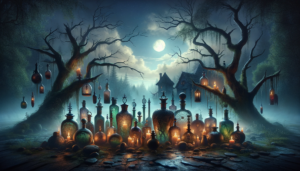
One of the popular amulets against evil forces in the 17th and 18th centuries was the so-called “witch’ bottles”. The bottle was filled with the urine of a patient (in whose illness the witch was suspected), cuttings of his hair and nails were added, the resulting mixture was seasoned with nails, corked, and buried under a threshold or fireplace. With such a bottle, any attempt to cast a jinx on the inhabitants of the house would cause the witch unimaginable torment.

The contents of the bottle varied according to local superstitions or the personal preferences of its maker. The bottle found in a Suffolk cottage in 1860 contained 200 pins. In the early 20th century, a fish oil bottle was found immured in a chimney stack in a store in Padstow, Cornwall. The contents of the bottle were even more unpleasant than rancid oil: inside was perfectly preserved human urine, and the cork was pierced with nine pins.

During construction works in 2009 in London’s Greenwich district, a truly unique 17th-century ceramic vessel was found. At first glance, it can be taken for a jug of wine, but the builders did not want to uncork it and passed it on to laboratory analysis. And they did the right thing because the find turned out to be a real “witch bottle”.

Its shape was not accidental either. Similar ceramic jugs were made in the Rhineland region of Germany. Each jug was decorated with an imprint of a bearded face, which symbolized wealth and prosperity. In the second half of the 16th century, the mass export of Rhenish pottery to England began. Innkeepers kept English ale in solid German jugs. Over time, the increased demand for Rhenish pottery led to a decline in quality as the potters could not cope with all the orders. The image of a bearded man became increasingly stylized and, therefore, somewhat creepy.

In England, this type of pottery was dubbed “Bellarmine” in honor of Cardinal Robert Bellarmine, an ardent opponent of Protestantism. During a fierce debate, King James the First of England called him “the Antichrist.” The nickname stuck first to the cardinal and then, by association, to the jugs. And since the jugs really were so satanic, it was decided to use them on the principle of “fight fire with fire.” Most 17th-century witch bottles are Bellarmine jugs.

The contents of the Greenwich bottle were somewhat unusual. In addition to the main ingredient, i.e. urine, the jug contained human hair, nail clippings, and nine bent nails, one of which had a heart-shaped piece of leather threaded onto it. All of this was laced with sulfur, also known as a powerful antidote to witchcraft. Of particular interest to the researchers were the nail clippings. They still had traces of manicure and looked nothing like the rough nails of a simple laborer. Consequently, their owner was at least a man of average wealth, but even such people were prone to superstition.

Glass rolling pins.

English sailors used to give their wives and girlfriends glass rolling pins. These rolling pins, made of multi-coloured glass and with sentimental inscriptions, were not used to roll out dough but were kept as a talisman. A cracked rolling pin presaged shipwreck and impending disaster. For the most part, the pots were hollow, with a cork at one end. They could hold tea or rum, but superstitious sailors filled them with salt to ward off the evil eye. Other glass containers hid the dried “shirt”, i.e. the watery shell of the fruit. According to beliefs, it kept the sailor from death out at sea.

Share
Error: View 553bc56gsl may not exist
SIGN-IN
SIGN-IN
  • About Us
  • Education
  • Departments
  • Schedule
  • Store
  • Forum
  • Library
  • Videos
  • Books
  • Articles
  • News
  • FAQ

About Us

Here we teach about magic, Runes, the four Elements and Tarot.

Ksenia Menshikova is the founder and head of the School, author of books on the development of magical abilities

The mission of the Menshikova School is to develop people’s magical and occult abilities, including all the skills that relate to our hidden potential within.

Magical consciousness is not “a gift from above”. It is the result of self-transformation by the means of one’s will and intelligence. Only the one who possesses the will and mind power can become a true Mage.

Contact Us

If you have any questions on admission and learning process contact the school coordinator: info@mages.school

On the matter of store and orders contact admin@mageschool.store

The MAGIC UNITED forum is supervised by the mentors of the School. You can read the latest news, post your messages, give your feedback (share your opinion) or ask questions there.

Sections

  • About Us
  • Education
  • Departments
  • Schedule
  • Store
  • Forum
  • Library
  • Videos
  • Books
  • Articles
  • News
  • FAQ
Subscribe to our newsletter for the latest school news and event announcements
https://t.me/SMK_Official_channel
Facebook
Youtube
Instagram
Medium
Pinterest
Twitter

Menshikova School © 2026. All rights reserved.

Scroll Up