

Imbolc
(Gromnitsa)
February 1
On this day, after a long rest, the element of Air is the first to awaken. For the world of humans, Air is the governing element, and the mental body—its creation—is designed to balance the cognitive needs of the superconscious with the survival needs dictated by the subconscious. Humans are unstable beings and constantly try to break free from the overall rhythm of processes. In order for the magical law of balance to work in a person as it does in the entire Universe, the consciousness requires a regulator, a gyroscope, that will bring it into resonance with the universal processes, so that neither the individual nor all of humanity as a whole becomes superfluous, foreign beings who not only fail to assist in the universal development, but actually hinder it.
Although Air is considered a masculine, “penetrating” element, this day was ritually connected with the goddess Brigid (Brigitta), the mother of the gods. She is the guardian of tradition, skilled in all arts and crafts, and is the one who bestows what is called inspiration. The triple goddess, as the goddess of fate, determines the major changes that must occur throughout the year. Her triple essence is reflected in human consciousness as the unity of the conscious, subconscious, and superconscious. It is the law of unity and the law of cosmic equilibrium that are activated by the power of the Air element as the primary operational system.
In ancient times, the goddess Brigid was depicted as a bird with a human head, and only in later periods did she take on a purely human form, becoming the mother of crafts. Her most ancient function was that of the resolver. The threefold goddess, who appears in one form or another in all pagan traditions, embodied the will of Mother Earth. She is the one who releases the wind, the carrier of information from other worlds, and simultaneously the medium for its dissemination. As an unheard-of and unseen bird, those who were able to see her understood her will through her form and song: whether as the Sirin bird, the Alkonost, the prophetic Gamayun, the ravens Morrigan and Badb, or the striges of Hecate—great manifestations of Mother Earth as the force of cosmic order.
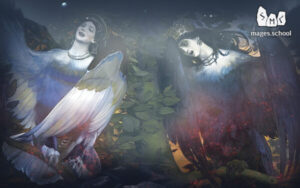
The bird, as part of the goddess’s image, reveals its purpose in this role: now it is the herald. Its element is Air, and it, flying through the gates that are open only to the force of Air between worlds, carries with it information—the knowledge of other worlds. The dust of distant roads, brought by the Air element, will settle in this world, inevitably altering reality. In six months, the Air element will journey to other worlds, and the dust from your roads will be carried by the winds of Mother to where changes are destined to take place. This is how balance is established on this level—every piece of information must be taken into account. No world exists on its own—everything is interconnected. The power of the Air element, as the pioneer, leads the other elemental forces, like a herald before the king, preparing the space for the arrival of necessary changes.
The volhvs and druids of old caught this flow, receiving the information brought by the wind, and their wisdom, along with centuries-old magical knowledge, helped interpret it correctly, providing essential knowledge: what changes to expect, what is certain to happen, and which trials must be prepared for in order to navigate them with dignity and with minimal loss for all.
The people, taking part in the Imbolc ritual, would offer Brigid, the mother of Winds, offerings—milk, bread, and grain. They would appease the goddess, asking her to “ask her sons to carry away misfortune and bring joy.” In the ritual action of the people, this festivity was connected with purification, as taught by the sages, priests of the gods-ancestors, the volhvs and druids—mages who maintained the connection with the masters of this Earth. For a person, purification is freedom from the unnecessary; for a mage, purification is the alignment of one’s consciousness with the common breath of the Universe, the activation of the law of equilibrium within the consciousness.
People, living with their small sorrows and worries, joys and hopes, rarely concern themselves with the fate of the world. They are mainly interested in their own well-being, the well-being of their children and families. The cause-and-effect connections of “everything with everything” are felt on a reflex level but are typically not consciously understood. This has been the case, is the case, and will likely continue to be the case. But a mage, leading their tribe or people, must not concern themselves with just one individual, one particular family, but with the whole nation. Their understanding of the relationship between humanity, nature, and the world must not be purely intuitive.
This is why the ancient volhvs and druids, mages of the old traditions, understood the true meaning of rituals of awakening and slumbering of the elements. Alongside the people, they still perform their rites of attunement with the forces of the worlds.
The awakening of Air
Thus, at the moment of Air’s awakening, at the moment when the spirits awaken, the mages of the past—volhvs and druids—performed rituals of unity with them, feeding the awakened forces, honoring them with what they had, symbolizing: “We are one family; if we must face trials, we will face them together.” From this, it is clear that ritual offerings to the Triple Goddess were meant to feed all those who constitute her airy aspect—winds, air spirits, sylphs, fairies, and prophetic birds. Their presence alongside the human world throughout the year helps maintain order and prevents irreparable consequences. They will drive away collective misfortune, removing the cause of the problem locally—punishing one, but saving all. But if the spirits turn away from a person, the mistake of one may bring ruin to the entire tribe.
The ancient mages, understanding the true power of the children of Brigid, the children of Mother Earth, performed rituals to ensure the safety of the entire people and tribe. The people, through their simple participation, offerings, and gifts, performed a vital task: they disengaged the resistance of their consciousness and strengthened the mage’s spells and rites through their agreement with the common law of Nature: the unity of everything with everything.
In the Slavic tradition, Imbolc was known as Gromnitsa.
It was believed that only on this day could thunder roar in the sky (which, by the way, is still true, and the belief persists today). From this moment, the “dark period” was considered to have ended, and a new cycle began. While Gromnitsa was not celebrated as widely as the Celtic Imbolc (the reasons for which will be explained later), the Slavs still participated in the global ritual processes. However, while the ritual of attunement to the element of Air was performed primarily by the sorcerers, the rest of the good people participated in connecting with nature in their own way: cleaning and washing their homes, fumigating livestock, venerating the god Veles—the god who unites the worlds, the god who watches over order in both the world of humans and that of non-humans. And of course, they honored the spirits—our native Russian “unclean” spirits.
Immediately after the celebration of Imbolc, as a point of power, in Slavic tradition, Gromnitsa evolved into the modern holiday—Kudesy, the day of the domovoy’s (household spirit) birthday. The domovoy is the household spirit (called “brownie” by the Celts and “nisse” by the Scandinavians), who has an airy nature and also awakens during this period. Kudesy was celebrated on February 10th, and on this day, it was customary to appease “one’s own” domovoy—with gifts, offerings, and kind words, showing him, as a representative of the elemental forces of the household: “Be with us, grandfather, we are not your enemies, we are your family.” The domovoy, as the connection between the world of humans and non-humans, could protect the household from negative forces, and could also attract positive ones—but only for a single family, not the entire tribe or nation.
Today, in the vast expanse of the Internet, amidst the overwhelming flow of information aimed at reviving old pagan traditions, one can find a great deal of material that largely repeats itself. This mindless copying of texts creates a gray noise in the informational space, preventing the ability to see that information about old pagan traditions is often richly seasoned with Christian counterparts and attempts to merge the unmergeable—monotheism and paganism. This is particularly true in Wicca—a neo-pagan system that seems to try to revive the ancient cult of worshiping the “God and Goddess.”
Unfortunately, the result is null, because the old tradition can only be revived by carefully separating it from the new, not by mixing mutually exclusive ingredients in one pot. The coarse must be separated from the subtle with caution and skill, as stated in one hermetic treatise. But if one tries to bow in all directions at once, one will be drawn into this endless cycle—it’s a trap. For this reason, the true meaning of ritual actions has slowly but surely faded from the informational field and from the collective memory, but fortunately, not entirely.
There is a rule of preserving pure knowledge, and it was preserved in the Western European schools (which include not only Celtic traditions but also Slavic and Northern traditions). If you can understand the magical meaning of each ritual, the ability to perform it, as well as the knowledge of what information about it is true and what is false, will come naturally, like part of ancestral memory, like the memory of the blood.
Imbolc is a calendar holiday and is tied to a specific date—February 1st. However, the ritual period can last longer: from January 31st to February 2nd, inclusive.
Excerpt from the book “Heath through the Power of the Elelments” by Ksenia Menshikova
Other pagan holidays of the Weel of the Year:
1 Imbolc 2 Ostara 3 Beltane 4 Litha (Kupala) 5 Lughnasadh (Lammas) 6 Mabon 7 Samhain 8 Yule
FORUM “MAGIC UNITED”: Festivities and Mysteries, the Wheel of the Year: Imbolc
THE MAGAZINE: “THE WHEEL OF THE YEAR”