
Ostara
(Zhavoronki, Soroki, Komoeditsa, and the Spring Equinox)
March 20th-23rd.
During this period, the element of Water awakens. Stirred by the Air, it moves forward, propelled by the flow, heading into the future, creating space for what is to come.
Any action, any creation requires energy. And this energy must be pure, boundless—the greater, the better. Such energy exists, and its essence lies in the element of Water—it is the energy of Chaos.
The date of the Spring Equinox is not fixed, and it is calculated each year, though it falls within specific limits, with only the hour of its arrival changing. As with the previous holiday, ritual actions for the people and for the mages (priests, volhvs, and druids) were different. The task of the people was to feel the element, to attune themselves to it, and begin to exist with it in its altered rhythm. The task of the mages was to ensure that the element did not perceive the participants in the ritual as outsiders and to align the internal vibrations of the living with the natural vibrations of the element. To achieve this, under the guidance of the mage, the people performed ritual actions that symbolized the death of the old and the birth of the new—this is the function of the force of Chaos. Chaos can dissolve everything within itself, but it is also the material for the creation of something else. At this moment, the person must become light and fluid, like water. They must not cling to what is outdated, nor become a stone in their own shoe. The space cleansed in the previous phase must now be filled with new strength, and the water will wash away everything that has clung to life against its will, against the desire of the living being.
The burning of the effigy, as part of the ritual, also symbolized the process of liberation from the old. The effigy was made from last year’s straw, old winter bedding, and, importantly, it contained seeds from the previous harvest. In this way, symbolically, it represented detachment from the desire to accumulate excess: what was taken from nature but is no longer needed now, let it return to its primordial form—in warmth, in light, in the earth—and the ashes would later be scattered across the fields for the future harvest. The effigy was never seen as a symbol of the gods of winter or the dark world. No one living in a pagan worldview could even think of burning a symbol of a dark, yet divine, being, as that would be an act of disrespect towards Death itself. Such thoughts, let alone actions, could easily lead to one’s demise before the next winter.
Ritual is a process that requires time. It is impossible to perform a ritual casually, in parallel with other tasks. For this reason, on this day, as with other sacred holidays, people left behind their current concerns, no matter how important they were: wars stopped, conflicts ceased; people did not engage in domestic or household chores, which later became reflected in proverbs, signs, and beliefs of many nations.
The magical moment of adding the power of awakened Water for the ancient mages was based on the fact that, alongside the power of creation for the future, a connection with the gods was established and strengthened. The strength and authority of these gods helped the people not just survive but thrive in prosperity and abundance. This prosperity was understood as the gifts of the earth, its ability to give birth to and nourish all of its children. It was this quality of the earth as Mother—young in its awakening, ready to give birth and nourish, free from any morality or limitations—that was celebrated by the ancients on the day and hour of the arrival of spring.
Goddesses from different pantheons of ancient cultures were honored at Ostara, for each land has its own gods: Aphrodite, Astarte, Demeter, Hathor, Ishtar, Kali, Ostara (Eostre), Freyja, Lelya. All of them symbolize freedom and fertile power, where the sensation of life brings forth hope. On the day of the Spring Equinox, night is equal to day, life is equal to death. Entering this period, in the consciousness of all living beings, this knowledge becomes manifested, as if exposing the fleeting nature of life, as though saying: “People, live now, live in the present, do not delay.”
The awakened Air has awakened the Water, and together they have set the Wheel in motion—time has begun. This is why, for people, the true New Year begins on this day—the day of the Spring Equinox. The celebration of the coming Spring is the celebration of time that they will now surely have. The New Year for mages, volhvs, and druids began earlier, at Imbolc. Tradition dictates that their consciousness must be in synchronicity with those among whom their magical minds dwell, rather than with the human body. The body of the volhvs and druids belongs with the people, but their minds belong with the spirits.
The main symbols of the holiday of the young Maiden-Goddess are the hare and the egg.
The hare is a symbol of fertility, as the ancients who worshiped the Triple Moon Goddess often saw the image of a hare on the face of the full moon. Many lunar gods of ancient times had the hare as their symbol. The occult significance of the hare symbolizes rebirth, the return of youth, as well as intuition and “light in the darkness.” The hare is frequently associated with sacrificial fire and “life that has passed through death.” Everywhere, the hare is a symbol of fertility, but not of human fertility—rather, that of nature. Only in Christianity does the hare become a symbol of debauchery and Satanic lust, and in Judaism, the hare is considered an unclean animal.
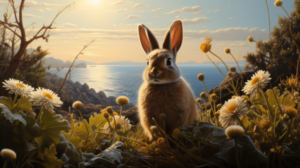
The hare on the moon appears in mythology nearly everywhere, and as a lunar animal, alongside the dog and the lizard, it serves as an intermediary between humans and the lunar deities. In Norse mythology, hares serve Freyja. The Egyptian moon god Osiris, in the form of a hare, symbolized moral purity.
The egg represents the cosmic egg of creation. Life that is in the process of formation: it already exists, but it is not yet. An entirely mystical state of primary creation, where it is still possible to lay the necessary qualities for the future reality in such a way that, at the moment of its manifestation, those qualities become inseparable from reality. The tradition of painting Easter eggs originates from the ancient symbolism of the Goddess of Life, the youthful face of Mother Earth. People of old times, painting eggs, adorned them with their dreams—hope. Each person painted on their egg the life they wished for themselves. But they never boiled the painted eggs, let alone ate them. The decorated eggs were gifts for the goddess of Spring and Life. A boiled egg represents dead life, a killed hope—a life that could have been, but now will never be. Eating it symbolizes sacrificing a killed dream in favor of a tradition that denies life and glorifies death. “Egg tapping” is a symbolic battle between people, where victory means that the dream of the winner will come true, while the dream of the defeated will not. Formally: whether or not the dead sacrifice is accepted by the dead god.
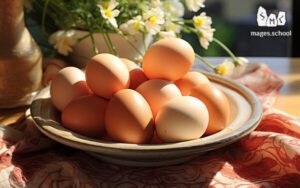
A decorated egg is a letter, a message. A plea to the Goddess of Life to consider the fulfillment of desires and well-being in the fate of the coming year.
The structure of the egg, as a symbol of future life, complete in its formation but not fully manifested, possesses all the qualities of the elemental forces: the shell is the earth, the white is the water, the yolk is the fire, and there is space for air—an air bubble. A small universe, a complete reality—this is how the ancients saw the egg. For mages, the egg in this sense is a symbol of tradition—a finished system, which has the potential to become alive. Such a magical structure of the egg is a universal mechanism for transferring information. This is why sorcerers, since ancient times and up to the present day, use eggs for removing negativity, for curing illnesses, fears, and other afflictions whose causes are informational in nature (events, spoken words, curses, etc.). Only when extracting a negative program and transferring it through special words (incantations) to the egg, it is not sent to the gods of life, but to the gods of death (buried in the earth, submerged in swamps, or buried in cemeteries, etc.).
For certain magical lines of druids, eggs were considered sacred and therefore forbidden to be used as food.
Magical rituals
Magical rituals performed by volhvs and druids on the awakening element of Water on the day of the Spring Equinox were different from the rituals performed by the people. The rituals of the mages were one step ahead of the ceremonial actions of the people: all the informational content of the future reality had been created by the mages in the previous phase, at Imbolc. This “programming of reality” was never done by the mages of ancient times based on their small human passions, fears, and hopes—those things were no longer present in the mind of the one who first meets the guests from the realm between worlds. The information of the future comes from the gods who arrange reality, and the mages, volhvs, and druids passed this knowledge through their empty minds, freed in advance from all things human, transmitting it to the world in its unaltered form—through breath, through the power of the Wind, and through the secret Word, spoken to the Wind. This information arrived with the winds of Imbolc and emerged on the waters of Ostara. In the mage’s consciousness, only pure knowledge remained—a vision of the future. He concealed nothing, giving the Water the knowledge of the Winds, but added nothing from himself.
People, unlike mages, priests, volhvs, and druids, have the right to think not about all of humanity, but only about themselves. On Ostara, they repeat the step the mages took on Imbolc: they take an egg and, painting it with ancient symbols of the proto-language, add their own personal tasks to the general program of reality. No longer with words, as the mages do, but by representing that word. At this moment, it is the task of the sorcerer and druid to inscribe these personal tasks into what must inevitably be, ensuring that the people’s desires come true, that there will be enough strength and time for their realization, and that the people’s desires align with the Word brought by the Winds from the world of the gods.
But the complex matters of magical flows hardly concerned the simple hearts of the living. Following their priest, people translated the deep symbolism of their actions into a form they could understand. In this way, they became more aware of the connection between what was happening to them and the Earth, and they drew closer to their gods, although in reality, they simply simplified them, fixing them in a form pleasing to the human heart. In the awakening spring, in the stirred power of Water, they saw the emerging love between the youthful Goddess of Earth and the young God of the Forests, Cernunnos, the young Veles, the Green Man, the Horned God. The egg, as the future fruit of such love, symbolized the son, the new young ruler of the future, who would surely be born to the goddess—the young god of the past and the future.
The pure consciousness of the children of Mother Earth knew nothing of indecency and never perceived the natural breath of nature as something vile and sinful. This vision of the awakening young goddess became sinful only much later in the eyes of strange beings who saw as an offense the fact that nature lives by its elemental laws, without asking permission from their no less strange desert god.
Ostara is a hymn to freedom and life. It is the veneration of the power that Mother Nature has endowed every living being with, and this power will never submit to anyone’s prohibitions.
On this day, the Slavs rejoiced at the return of the birds. It was believed that on this day, 40 species of birds returned home, with the first to arrive being the lark. Hence, this holiday was popularly called “Larks.” People knew that birds, whose element is the sky, know the future in advance, and if they return to their land, it means that nothing bad will happen here, on this land.
Excerpt from the book “Health through the Power of the Elements” by Ksenia Menshikova.
Other pagan holidays of the Weel of the Year:
1 Imbolc 2 Ostara 3 Beltane 4 Litha (Kupala) 5 Lughnasadh (Lammas) 6 Mabon 7 Samhain 8 Yule
FORUM “MAGIC UNITED”: Festivities and Mysteries, the Wheel of the Year: Ostara
THE MAGAZINE: “THE WHEEL OF THE YEAR”