
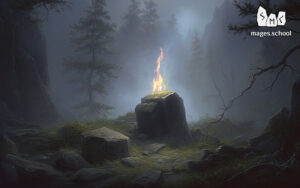
Samhain.
(The Night of Veles).
November 1st.
From this day forward, the Earth falls asleep for six months. The power of the Element grows quieter and quieter, no longer able, by its active will, to influence what happens to all its children. It can no longer support the weak or call the strong to order. And so all people and non-people, spirits and half-spirits, inhabitants of every world, become as if left to themselves, to their own will. The Law no longer presses upon them; only their good intention to live in harmony with others—and with one another—retains meaning.
At the moment of transition, on the night of Samhain, the veil between the world of the living and the dark realm of the dead is lifted, and our worlds draw so near to one another that mutual influence becomes possible without prohibition. On this night, the dead may call the living to account, and the living the dead. It is the only night of the year when debts may be demanded from those who have departed into other worlds. Yet, by the law of reciprocity, they too have every right to demand the same.
That is why, on the eve of Samhain, it was customary to commemorate the departed and invoke the ancestors. This helped not only to soften the potential wrath of the dead, but also to summon the strength of one’s kin for aid on this fateful day for each person.
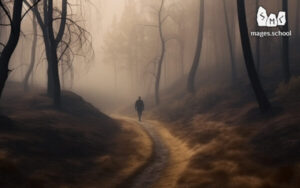
Help and support were essential, for from this night onward the power of the Earth ceases to sustain humankind. The bond with one’s roots and lineage weakens; it is as though the ground slips from beneath one’s feet. If a person has achieved nothing through their own efforts, if all their strength and significance rest solely upon the accomplishments of their forebears, then the Night of Spirits reveals this immediately. Dark forces, as has been said before, are harsh and merciless teachers. Thus, the Night of Samhain becomes a night of the final examination for all. The dark energies pouring through the doors flung open at Samhain strip away every illusion previously constructed.
The young god has departed into the World of Darkness, into the realm of the Nine Ancient Mothers. Air and Water fall asleep. A period of timelessness begins, and nothing now strengthens a person as an independent being—not the power of kin, nor the power of time granted by their Orlog. Will they endure? In this moment, it is the individual’s own Wyrd that is subject to judgment—their personal fate, as both the measure and the right to influence it through reason and will.
On the night of Samhain, the doors open not only to the realms of Death and Darkness. When the power of the Earth cannot manifest the fullness of its will, it becomes vulnerable to the arrival of “foreign fire.” Fiery gods from various worlds may pass through the opened gates into the world of the Mother, seeking conduits—those who are “assembled” from the four Elements, those capable of receiving the Element of Fire and transmitting it to the Earth, those who live within the current of time shaped by Air and Water. Such a being is the human.
Alien Fire can be exceedingly powerful—so powerful that a fragile human soul may struggle to withstand the will of new, invading fire-gods. They are borne on the spears of warriors from distant lands. They are carried in the satchels of “weak” refugees and settlers. They arrive aboard merchant ships, concealed among heaps of silk and gold. They may appear suddenly behind the smiles of missionaries in white shirts. They can come from anywhere and in any guise.
How are they to be recognized? They cannot be. Yet they are powerless if, instead of the pliant consciousness of a slave, they encounter the strength and steadfastness of a warrior. If a person, torn from their roots by the magical force of the Spirits of Samhain, demonstrates that their strength has not diminished—that with or without ancestors and gods they remain the same: strong, loyal, steadfast, and free—then no new “light-bearer” is to be feared. Like a son standing guard at the chambers of his sleeping Mother, he will keep watch and will not allow the invading violator to enter.
This is a magical parable. Yet the volhvs and druids of old attached the utmost seriousness to what transpired on this day. The principal and most important rituals for invoking power—not merely venerating it—were performed precisely on the Night of Spirits. The mages of earlier times acted in unison, carrying out the rite known as the “Keeping of the Fire.”
To perform this ritual, the druid-mage or volhv-mage had to rely not only on the strongest and most steadfast among humankind. Standing shoulder to shoulder with him were to be the other children of the Mother: the forces of both the Dark and the Light worlds, the spirits of the forest and the river, all the powers of nature that had not yet fallen asleep, and the ancient forces that had already awakened. He invoked the Ancient Gods from other Worlds and the Guardians of the Paths, whose task was not to interfere in human affairs, but to safeguard the boundaries between the Worlds. Despite all former rivalries, on this night old childish quarrels were to be forgotten. In the face of a common threat, all the children of the Mother were to remember their kinship through her and recognize the existence of an entirely different enemy.
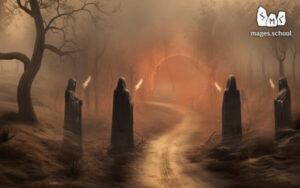
For this reason, the ritual of kindling the fire held such profound significance on this night. No one had the right to light a flame before the druid had done so—before the mage had spoken all the incantations and established a channel of connection with the Primordial Fire—until all the forces willing to defend the sleeping Mother Earth stood together with humankind, shoulder to shoulder and back to back, rather than facing one another in opposition.
In kindling the magical Fire, the druid summoned it in its primordial form—one that does not exist for human use. It is the fire of Zeus-Jupiter, the fire of Semargl, the fire of the Dagda, the fire of the Fomorians, the flame of Surtr—the power and essence of the Firstborn Titans. Only the Primordials could withstand the intruder. Yet it was essential that all the children of the Mother, preparing for the coming night of the battle of Ragnarök, stand together today in harmony, without any opposition among them. Not to appease, but to negotiate; not to beg, but to listen to requests; not merely to summon, but to be summoned oneself.
It is not the Light contending with the Dark on the night of Samhain. Rather, they stand united against the one who divides them into “light” and “dark,” who separates brothers and severs them from Mother Earth. For this reason, the time of Samhain later came to be called the “time of reconciliation” or the “time of accord.” Today the deeper meaning has been forgotten, yet the name remains—and even reemerges in unexpected places and unexpected forms.
Celtic tradition revolved around the date of Samhain. It was Alpha and Omega, beginning and end, the point of departure and the moment of reckoning. The principle “From Samhain to Samhain” applied chiefly to those whose lives were not devoted to working the land. It was the principle of the higher castes: warriors, rulers, nobility, and, of course, the druid-mages.
“All significant mythological and epic events are concentrated around it (Samhain); within it they find both their foreshadowing and their epilogue: it is as though time itself were compressed within it.”
Françoise Le Roux, Druids
Of course, in that era it was considered entirely natural that an alien force would consume the weak human consciousness of those who failed to withstand the final examination of the dark spirits and proved themselves unworthy of either the Mother’s power or the strength of their ancestors. Yet how difficult it was to foresee that very soon the weakest would be all—that they would betray their gods, turn away from the Mother for the dubious promise of a “kingdom of heaven,” and surrender the earthly kingdom without a fight. But the law of Samhain is inexorable: victory is possible only together.
Among the Slavs, Samhain was known as Veles’ Night. Veles is the god of the universal order, a shapeshifting deity, master of magic and hidden knowledge, lord of crossroads, a chthonic god whose dominion encompasses the worlds of Yav, Nav, and Prav alike. He opens the gates between the worlds, helping the living receive the blessing—the strength—of their ancestors who have passed into Nav. The volhvs, like their druidic brethren, invoked on this night the “pure” fire of the god Semargl and established contact with the progenitor Svarog. The aim was the same: the coming great battle upon the Kalinov Bridge—our Fire Gods against the gods of alien, barren flame.
On this night, every mage seeks to contribute to the unification of the worlds, to the reconciliation of all the Old Gods, to the restoration of the ancient bond among all the children of the Mother. A difficult period begins—a time when Fire stands against Fire: one’s own against the foreign.
When the White Áss Heimdallr, son of the Nine Mothers, sounds his golden horn, Gjallarhorn, the battle will commence and continue until the days of Yule enchantment, in which the strongest must prevail.
After Samhain, the force of the Element of Fire reigns supreme in the world. Fire consumes biomass, and a human being will not endure this time if they themselves are merely biomass. Yet Fire cannot consume the Earth; it cannot melt solid stone. It only makes it stronger; it tempers and hardens it. Here, each receives a reward according to their merit.
Excerpt from the book “Health through the Power of the Elements” by Ksenia Menshikova.
Other pagan holidays of the Weel of the Year:
1 Imbolc 2 Ostara 3 Beltane 4 Litha (Kupala) 5 Lughnasadh (Lammas) 6 Mabon 7 Samhain 8 Yule
FORUM “MAGIC UNITED”: Festivities and Mysteries, the Wheel of the Year: Samhain
THE MAGAZINE: “THE WHEEL OF THE YEAR”