
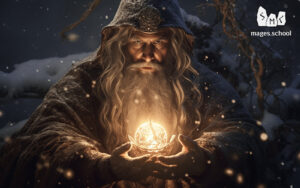
Yule (Winter Solstice).
December 20-23.
From this point onward, the period of the dormant Fire element begins. On the longest night of the year, another turning point occurs, one that sums up all that has been done. Yule is the conclusion of the battle and its result — whose victory is it?
The slumber of Fire is a period of relaxation and rest for all those who, throughout this time, underwent the trial of loyalty and resilience, who held the defense shoulder to shoulder with the gods and the heroes of the past, with their brothers from various worlds, united by a common strength — the power of love for the Mother. The end of this battle is heralded by the horn of the god Odin (Woden), the leader of the Wild Hunt.
To see or hear the Hunt during the days of Yule is a sign that there will be significant changes in one’s fate. But in which direction — for the worse or for the better — only the result of the internal battle of Ragnarök will determine. Only truly courageous individuals survive when the Hunt passes by them. The weak and the will-less, those who betrayed themselves and their force without even trying to stand up for themselves, are immediately destroyed by the Hunt. The right to punish the deserters and honor the heroes is sacred for the gods on the nights of Yule. An enormous cavalcade of riders gallops through the air, and the black dogs, howling and choking on their own barking, announce the approach of the Hunt. In this ride participate not only Odin and the gods of his pantheon, but also all those who were betrayed by those they trusted.
The gods, who bestowed honors and knowledge upon humans, gave them protection and strength, call on this night for retribution for those who not only failed to preserve and multiply the gifts of the gods, but also gave them away to invaders voluntarily. On this night, the Ancients come to reclaim what is theirs, and no one can deny them this right.
By tradition, Yule lasts for 13 nights. This is a sacred period during which nothing is familiar. The multi-day tension disappears as if by magic, enmity dissipates, and the rejection of reality eases. But will, compressed like a spring, when suddenly released, leaps forward and upward with the force of its compression. This “leap” of consciousness is a measure of the power of spirit, and the higher it is, the greater the rights granted to the one who endured. The sharp moment of the extinguishing of Fire — and now the mind soars, joining the cavalcade of the Ancients. As they depart for their worlds, the gods impart their final knowledge: if a god is killed, it does not mean that he is dead. Everything can be changed, made different now. After all, there will be another battle, and the result could be entirely different. What matters is how you live through this year.
The Fire has fallen asleep, and now, for 13 nights, the goddesses of fate rule supreme — those who determine the personal wyrd (fate) of each person. The Norns, Moirai, Parcae, Makosh, Doliya and Nedoliya — many names exist for the Great Spinners, who, during these nights, begin their spinning. They weave the fates tightly until Imbolc, but it is during the Yule days that they lay the foundation for the future reality, where each thread represents the time granted to each for their personal wyrd. For some, they will become the main pattern of the future reality, while someone else’s thread will be cut off, unasked, if the Wild Hunt marks them as unworthy of power and time.
People fear Yule and await it. If they survive this dark night, the following days can be started with relief. The Hunt has passed, has not punished, which means there is still a chance to correct mistakes, rewrite the wyrd, and repay debts. Again, a great truce between Light and Darkness, but now Light will increase and Darkness will retreat.
On the night itself, people would burn Fire, gathering together, trying to feel protected. In the new period of the new god, the elders strictly forbade the young from leaving the house that night; it was forbidden to be alone, so as not to accidentally encounter the path of the Wild Hunt. These beliefs arose in the Christian era when the knowledge of the old times had been erased from people’s minds. Only fear and a burning sense of guilt remained, but no memory was left — of what they should be ashamed.
The pagan worldview of our ancestors did not allow them to remain behind strong walls on this night, like chickens huddling together on a perch. They would go into the open, where, before the idols of the gods, the volhvs had already lit a guiding fire in honor of the god Znich — the god of knowledge, the spark of the unquenchable Fire that lives within each person. During this period of “powerlessness,” when all the elemental forces are at their lowest, the volhvs would turn each person’s gaze inward, to check: had the spark of Kupala extinguished?
On the night of the Solstice, they honored the god Kolyada — the spark of the Kupala fire. According to legend, he always appears when it is necessary to save the children of Svarog from spiritual degradation. Long ago, he did exactly this: having come into this world, he gathered around him 60 sages from different peoples and taught them ancient knowledge, teaching them to think and understand the essence of things. He is the bearer of the primal spark from which a new Fire can ignite.
Kolyada is often depicted holding a sword, with the blade pointed downwards. This symbol is carried by all gods whose birth legends associate with the Winter Solstice, as well as gods who enlighten humanity — a prominent example being the legendary Prometheus, who brought the spark of the Gods’ Fire to the defeated and disgraced cowardly humanity in a reed stalk.
This small spark is not enough for deeds, but it is enough for understanding. And while the Air has not yet awakened, the Air that is able to kindle this inner fire through the flow of knowledge, one must find within oneself the singular source of strength that will constantly nourish the spark. This is the chance for the rebirth of the spirit, the opportunity to start over, and the small spark of the soul will, sooner or later, lead to the great Fire of one’s god, one’s force. This is the fiery bridge that the god Ovsen builds in the soul of every descendant of the Ancients — the path for the return of Kupalo, the son of Semargl.
Extract from the book by Ksenia Menshikova “Health through the power of the Elements”
Other pagan holidays of the Weel of the Year:
1 Imbolc 2 Ostara 3 Beltane 4 Litha (Kupala) 5 Lughnasadh (Lammas) 6 Mabon 7 Samhain 8 Yule
FORUM “MAGIC UNITED”: Festivities and Mysteries, the Wheel of the Year: Yule
THE MAGAZINE: “THE WHEEL OF THE YEAR”