
The Wheel of the Year
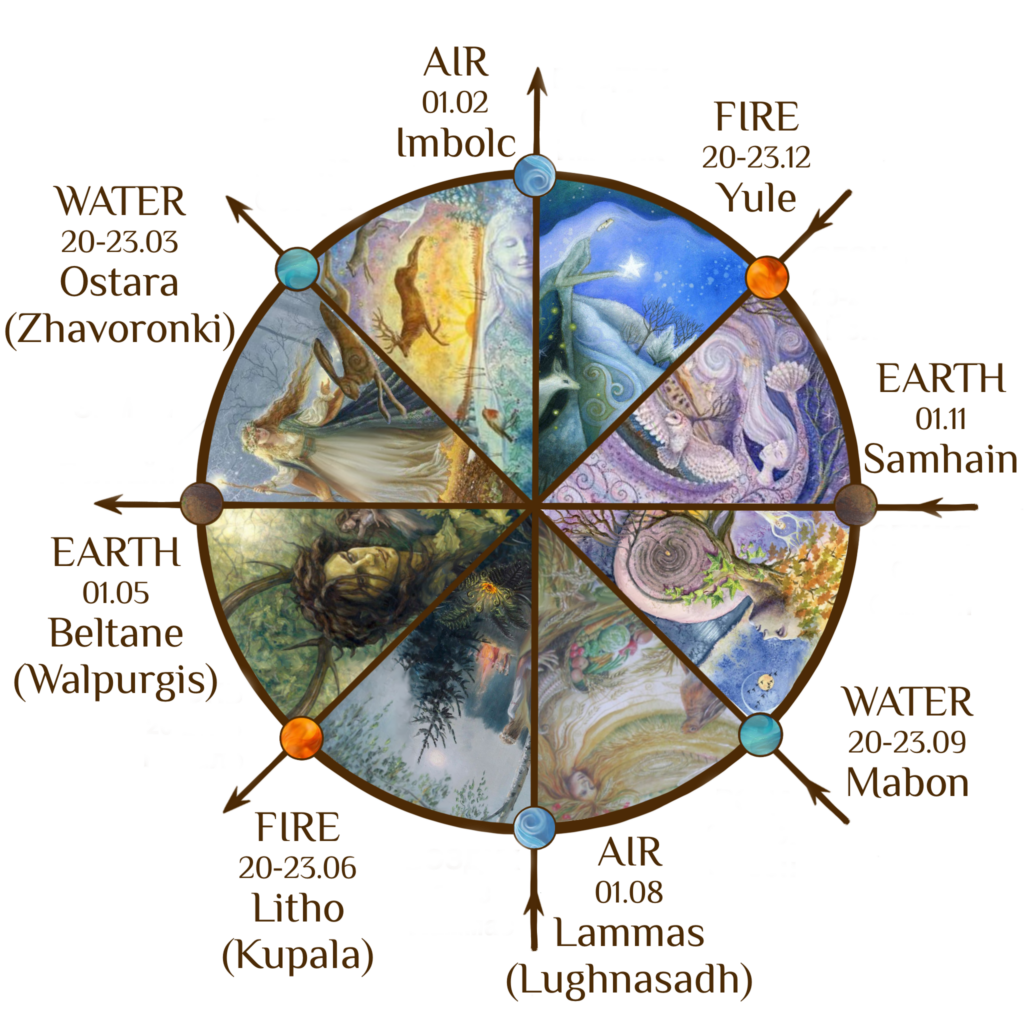
Elemental Powers In Nature
The foundation of the ancient pagan tradition lay in the inseparable unity between the human being and the forces of nature. This profound sense of indivisibility shaped consciousness, worldview, and, consequently, even the physical body of an individual (and at times entire communities), making them more sensitive to elemental changes and more responsive to their influence.
The fact that the modern human mind has forgotten this capacity does not mean that the body has forgotten as well. On the contrary, the body remembers perfectly. Yet, being dependent upon the higher spheres of consciousness, it rarely has the opportunity to express this knowledge freely.
Throughout the calendar year—the Wheel of the Year—all four elements pass through stages of dormancy and awakening, forming eight pivotal points: points of power at which transition occurs and the elemental structure of space is reconfigured.
The ritual traditions of the Slavs and Celts were designed to attune human consciousness to the field of natural forces precisely at these moments of transition, and in this capacity they were brought to remarkable refinement.
Ceremonial acts for the people and magical rites for the volhvs and druids carried within them the meaning of agreement. As the mind aligned itself with shifting vibrations, it seemed to say to nature: I am a part of you. I am with you. I do not resist. I, too, pass into a new state.
Yet the ability to feel the currents of elemental forces permeating space is not granted to everyone. What magical consciousness can accomplish is not always accessible to ordinary human awareness. A mage may rely upon sensation, may dissolve completely into the currents of forces, because they know these forces and do not fear them.
A human being, however, must not only feel but also understand. The psyche can trust reality more deeply only when its manifestations can be related to personal experience—when analogies can be found within one’s own inner world. This very feature of human consciousness became the primary cause for the emergence of Myth: a description of the processes of reality that explains its behavior in terms comprehensible to human logic.
For the forces of Mother Nature, the form of their manifestation is irrelevant. Yet the human being, regrettably, is attached to form and therefore compelled to determine essence through form. This is neither good nor bad; it is simply a characteristic of consciousness. It must be taken into account. And while doing so, one must not rely upon it as the sole criterion of truth.
Remember: form is a particular case of meaning. Form helps one grasp essence, but it is not essence itself, nor does it replace it.