
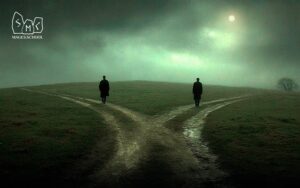
The magic of Troth and Seidr. Troth and Seidr – two paths of magical development in the Northern tradition: Troth is the Path of Service, and Seidr is the path of Sorcery.
The Magic of Troth and Seidr
(Excerpt from the Rune Course)
In the Northern tradition, there are two primary paths of magical development: the Path of Service, called Troth, and the Path of Sorcery, called Seiðr.
The Path of Troth
Troth, translated from Old Norse, means loyalty and is directly connected to the path of service — loyalty to the gods, to tradition, and above all, loyalty to truth. The path of service was originally considered a priestly path, because in ancient times the priest fulfilled not only a sacred function, but also the roles of lawgiver and ruler. Such a person dedicated their life to establishing the algorithms of truth, judging people, and guiding them so that through correct behavior and thought they would shape a proper future. In this way, the path of service later became known as the “light path.”
To teach people how to behave correctly, how to think, how to distinguish truth from falsehood, and how to live in alignment with truth — so that they fill the shared proto-foundations of Tradition and the structure of reality exclusively with authentic algorithms. With true information about what once was — without inventing anything, without introducing fragmented or false narratives. As long as paganism was alive, this was largely the case. But at some point, something broke. In time, we will find this fracture — and, of course, we will correct it. First within our own consciousness, and then within the consciousness of the entire world — but first, it must be found.
The working mechanism of the Troth path (traditionally considered a masculine path) was a tool known as Galdr. It is a general concept of governance — through runes, incantations, knowledge of mythology, and the ability to direct informational currents within human consciousness, explaining what is true and what is false. It is the understanding of laws and the control required to ensure that these laws uphold truth.
Throt, in essence, is the right to impose one’s will upon the world. It is the function of a ruler who has the final decisive word — the one who says: “So it shall be.” The path of Troth requires a lot of knowledge, and not only that, but that this knowledge be acquired not arbitrarily, but through the foundational vectors of transition — namely Jera–Jera–Nauthiz and Jera–Dagaz–Nauthiz. The functions embedded within these vectors and formulas are mechanisms for obtaining information strictly through truth, and through the appropriate component of elemental force — using precisely the amount of “fire” required.
The ability to distinguish truth from falsehood is like a test that one who chooses and enters the path of service must pass before the gods each time they are faced with the task of determining what is true and what is false. It requires considerable physical strength, as the strain on consciousness is significant. It also demands an excellent memory, since everything must be retained, along with the ability to consciously direct energy along this path.
The Path of Seidr
Seiðr is a mechanism opposite to Troth. The path of Seiðr unfolds through the rune Inguz and, accordingly, through the vectors Jera–Uruz–Inguz and Jera–Perthro–Inguz. These are different laws of life. Here, one does not control reality, but adapts to it. Reality is studied, and one learns to perceive and catch the currents of natural forces in order to integrate into them. Alignment with reality, merging with the currents of the world, and sensing the unified spirit of existence — this is the magic of the Vanir. This is what distinguishes it from the magic of Troth, which is associated with the Aesir, or more precisely, with the Jotunn current.
The Vanir are forces that do not burden themselves with long memory. While on the path of Throt truth is paramount, here the primary concern is that the world remains stable — whether something is true, false, or even dreamt holds no essential importance.
For Magical Consciousness, it is Essential to Master Everything
The Path of Priesthood — the path of Magic — was specifically designed to combine these two forces. Not to reconcile them, because they are always in conflict (and that is their natural state), but to integrate them within one’s own consciousness. In such a way that truth is preserved, and at the same time the balance of the world is not disrupted.
The gods themselves struggled with one another over how the world should develop. The Vanir said: “According to nature,” while the Aesir said: “According to our memory, according to the Jotunn law.” As you understand, neither side prevailed.
There were two attempts at reconciliation. The first was the creation of the god Kvasir — an unsuccessful attempt. The second was the process of mutual learning, which proved more successful. This effort was carried out by Odin and Freyja. As the lore says, Odin learned Seiðr from Freyja — she taught him sorcery, the laws of nature, and how to understand them. In turn, Odin taught Galdr, the runes, songs, knowledge, and the art of long memory. It is precisely because of this exchange that they became fully independent forces. Through this learning, they gained great power and became autonomous from one another.
These forces found within themselves the capacity to absorb what had not previously existed within them — despite reproach, mockery, misunderstanding from their own, and contempt from outsiders. This is true Magic. Because Magic fears no one and is constrained by nothing.
The world we live in now is not as pure as it once was — both Seiðr and Throt exist within it. One must transform their consciousness so as not to reject what seems unfamiliar or unnecessary, but to study it — and perhaps even discover something third — regardless of which path your force, your god, urges you toward. You must learn to master everything. Because it may be that the gods once failed simply because they did not know the other way. And so, it is you who must correct that mistake — by knowing all paths.
Additional Information:
- Rune studies. Runes Department
- Departments and Learning Structure
- Forum “MAGIC UNITED” – Runes Department
Literary Sources:
- The Four Magical Paths (excerpt form the Rune Course)
- The Yggdrasil Tree worlds
- A sacrifice for knowledge (from a Lecture on the Norse Tradition)
Videos:
- The Norse Tradition. Magic and Runes
- The Norse tradition in the history of magic
- On different illustrations of the Yggdrasil tree – is there an original source?
Educational Materials:
- Book. Runes Reveal The Mysteries of the World
- Book. Runes and Gods
- Book. The General Theory of Magic. The Northern Magical System
- Book. Runes: A Warrior’s Weapon